
There comes a point in any creative pianists life where they want to go BEYOND the basic triads and explore the satisfying texture of a CRUNCHY CHORD!
You know those chords that you hear and you FEEL such a warmth & depth that doesn’t come from the basic major or minor triads?
Those extra chord tones give that richness & complexity that we love about genres like jazz, soul, blues & all the derivatives of those genres.
But how does one ADD THE CRUNCH to their CHORDS?
Watch this 10-minute tutorial and download the FREE cheatsheet to start braving beyond basic chords today!
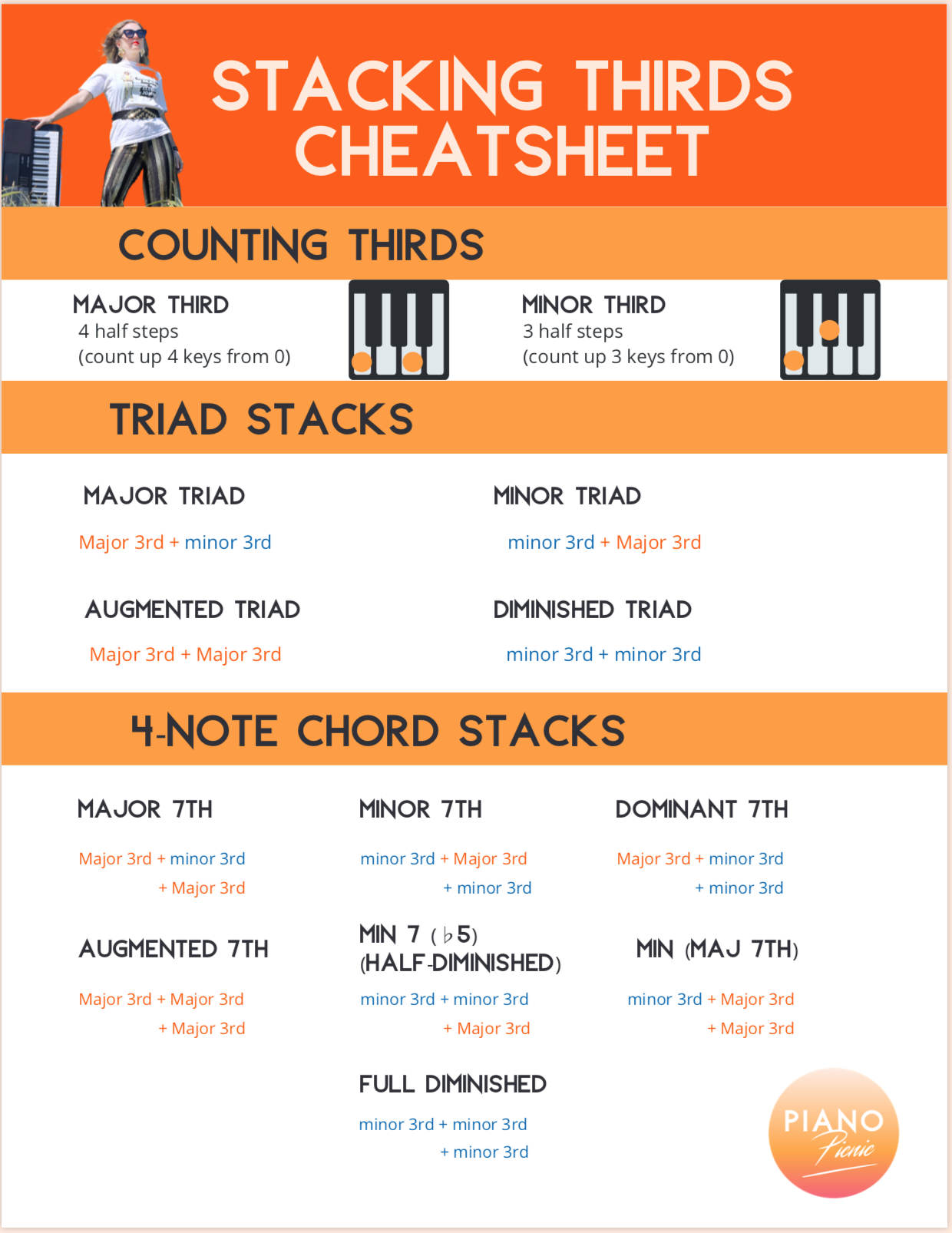
FREE PRACTISE-ASSISTING CHEATSHEET!
Easily practise your crunchy chords at home!
Want more? Try the coaching session ‘Advanced Chords Champion’!
Become a Creative Pianist member to access the COMPLETE VAULT of creative piano courses, workshops, song tutorials, support & community! Find out more about the membership!

Learning something new isn’t easy and even with an enthusiastic and encouraging teacher like myself, you still need to foster a decent amount of inner-motivation in order to put in the effort required to achieve your piano goals.

The ability to effortlessly flow across the piano keys without stopping is a technique that requires practise, patience and a couple secrets.

Are you enjoying what you’re playing? Are you getting that *𝖒𝖆𝖌𝖎𝖈* feeling that we all chase in our musical journey? Here’s how to purposefully find that feeling for yourself.

This is a much-requested topic from students who know how to play chords and scales, but struggle to sound confident and convincing. Discover the secrets to sounding cool, calm & collected gathered from 25+ years of performing experience!

What is meditative piano? Learn what it is, where it came from, what it sounds like and why it’s the perfect way to begin improvising on piano!

Discover how yoga can benefit your body as a pianist & performer through prep, maintenance and recovery routines.

If you've experienced any strain or pain as a result of playing piano – or maybe as a result of something else in your life but certainly exacerbated by playing piano, please know that it is normal! But just because it’s normal, that doesn’t mean you have to put up with it. Stretching into those forgotten corners of the body can do wonders for your energy, motivation and creativity too!

Playing rhythms is particularly difficult for pianists because we often play different rhythms in each hand! These exercises will help ANY musician (not just pianists) to feel rhythm internally and play as ONE cohesive rhythm, but with two limbs. [suitable for beginners and non-music readers!]

When you first decided to learn piano you probably didn't imagine you'd need to learn rhythmic skills, but once you get into creative playing that's exactly what you need to develop! So why is it so difficult to get our hands playing different things?

Revealing the benefits & steps to sticking with learning your scales to get your creative piano skills to the next level!

Feeling lost in the jungle of piano learning? This one is for you. In this free training I answer that I get asked all the time from beginner, intermediate & advanced pianists.

Discover the correct technique for playing scales with minimum strain and maximum warmup & exercise value!

Just the word 'scales' conjures up memories of dry, boring, regimented exercises - on this journey toward becoming a creative pianist, you might have imagined we'd be leaving scales in the dust, right? In this article you'll discover how creative pianists can use scales to their advantage!

Learn how to play the main riff from the classic 80s rock song ‘Africa’ by Toto on the piano in just a few minutes!

If you're in the market for a digital piano, these terms will definitely come up - what's the difference between weighted keys, semi-weighted keys, hammer action & graded hammer action? And which one is more desirable?

The one mantra that has FOUR different meanings that you can repeat to yourself whenever you lack the motivation to practise at the piano.

There comes a point in any creative pianists life where they want to go BEYOND the basic triads and explore the satisfying texture of a CRUNCHY CHORD! But where do you start? Here.

Learn how to play the main riff from the Mandalorian theme tune on piano! Carefully arranged for solo piano (from the original orchestral work) by Ruth Power of Piano Picnic. This casual tutorial will get you showing-off for all your Star-Wars obsessed friends!

Learn what makes the Piano Picnic style of learning different to the rest. If you haven’t done a course with me yet, this is the perfect introduction to what to expect, who’s suited to my courses, and the ethos behind my unique teaching style!

Today I’m going to show you my favourite finger exercise - it’s starts very simply and gets progressively more difficult each time you go up a level.

Free stuff! We love it! I’m something of a serial bargain hunter myself, but some things are just not a good idea to get for free: tattoos, candy from strangers and… learning piano.

I'm reflecting on 4 years of being a piano coach online, how I NEVER wanted to be a piano teacher and what I’ve learned about today's piano students (that shocked me!).

Learning piano is fun! It’s also challenging and rewarding, a form of expression and at times a source of frustration. But what we gain from learning piano goes far beyond the direct results we notice in the moment…

If you've been disappointed with traditional piano methods you're not alone. Here's why I believe the traditional methods of the past no longer fit today's amateur pianists.

In these strange times, many of us may be feeling like we have more time but less motivation to play the piano. Here are 5 tips to help you continue to progress even when you don’t feel like it.

Playing one thing and singing another, whether melodically or rhythmically different was such a challenge while I was learning piano! My only approach was to learn the piano piece so well that I didn’t have to spare it a thought, allowing me to focus all my attention on trying to sing properly. But there are other ways to improve at accompanying yourself singing…

Everyone knows they need to practice in order to improve their piano-playing ability, but a vast majority of piano students don’t quite know what to do, for how long they need to do it, and exactly what good it does!
In this post you’ll discover the science behind practice: how our brain responds to ‘quality repetition’ and how you can get the most out of your time.

Especially for the digital pianists, we start by looking at what the digital piano is made of, it’s many functions and what the buttons mean. Then you’ll discover exactly what you need to plug in and where.

Getting an acoustic piano from one place to another is something better left to the professionals. But for the brave ones determined to DIY this blog will show you what to expect.
With so many pianists starting their journey in childhood, it can feel like as adult beginners that we’ve missed the boat already. Is learning something new best left to the young? I talk to one of my students, Mike Clarke–a retired engineer in Australia–about his experience.